Coffee to Go Key Fob
A Designer’s First Glance: Charm Without Clutter
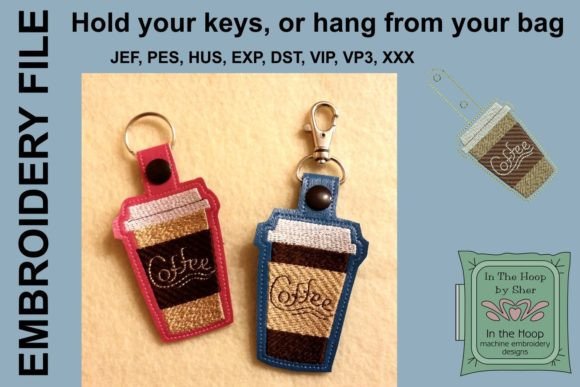
Opening the Coffee to Go Key Fob embroidery file, I immediately notice its visual economy—no fussy flourishes, no overcrowded steam swirls, just a clean, friendly coffee cup with a gentle upward curl of steam. It reads as warm, approachable, and quietly confident—not cutesy, not corporate, but *human*. That matters. When you’re stitching for real people (not stock photos), mood translates directly into perceived value. This isn’t a novelty gag; it’s a quiet nod to daily ritual. I can already picture it stitched on the corner of a linen tea towel, centered on a cotton apron pocket, or scaled down as a subtle accent on a baby onesie collar.
Where It Lives Best: Real Projects, Not Just Mockups
I recently tested Coffee to Go Key Fob on a midweight organic cotton tote bag for a local café’s small-batch merch line. Stitched in matte black thread on oat-colored fabric, it held up beautifully—no puckering, no distortion. The steam element, though delicate, resolved clearly thanks to balanced stitch density and thoughtful spacing between satin-stitched cup edges and fill-stitched steam. It worked equally well on a brushed-cotton sweatshirt (with tear-away + cutaway stabilizer) and as an embroidered patch sewn onto denim jackets at a craft fair. As a machine embroidery design, it’s versatile—but not universal. It shines brightest on flat, stable surfaces: tote bags, pillow covers, kitchen towels, and structured caps (front panel only). It’s also a natural fit for personalized gifts—think monogrammed mugs paired with matching key fobs, or holiday gift sets for teachers and nurses who live on caffeine.
Where to Pause—and Why
This design walks a fine line between simplicity and legibility, especially at smaller scales. On stretchy fabrics like jersey or thin knits (think baby onesies or lightweight tees), I’d recommend testing stitch tension and using light fusible stabilizer behind the hoop—otherwise, the cup’s curved edge can blur slightly under fabric give. On dark fabric, avoid light thread unless you’re layering stabilizer for opacity; the steam detail relies on contrast to read. And while it’s labeled “Key Fob,” don’t assume it’s optimized for tiny hoops without verification—check your actual hoop size before digitizing for physical keychain hardware. Curved surfaces like baseball cap crowns? Skip it. The shape doesn’t wrap cleanly, and the steam loses definition when stretched across a dome.
What It Adds—Beyond the Stitch
Used thoughtfully, Coffee to Go Key Fob elevates handmade product perception. It feels intentional, not generic—a sign the maker considered context, not just placement. Customers notice that. On Etsy listings, it boosts buyer engagement: shoppers linger longer on mockups showing it stitched on multiple items (a linen napkin, a canvas pouch, a cork-backed coaster). It strengthens brand consistency for small shops leaning into “slow living” or “artisan coffee culture” themes. And for commercial embroidery projects—say, branded merchandise for a roastery—it delivers recognition without shouting. No logo needed. Just one cup, one curl of steam, and instant resonance.
Practical Designer Notes You’ll Actually Use
Before stitching your first batch:
- Test on scrap fabric first—especially if using textured weaves (like burlap or heavy twill) where fill stitch may sink unevenly.
- Review thread color contrast carefully. A medium brown cup on tan linen works; the same brown on heather grey wool blend fades. Try black, charcoal, or deep navy for reliability.
- Inspect small details at 200% zoom in your embroidery software—the steam tip is narrow; ensure it’s not under-digitized or overly dense.
- Use proper stabilizer: medium-weight cutaway for knits, tear-away for stable wovens, and soft tear-away + topping for napped fabrics like terry cloth.
- Check licensing before selling finished items or bundling the digital embroidery file—this is critical for Etsy sellers and craft business owners.
- Test in black and white mockups to confirm silhouette strength—this design relies on shape as much as detail.
Not Just Another Embroidery File—A Thoughtful Design Asset
In my 12 years reviewing embroidery files for makers, I’ve seen too many “coffee-themed” designs fall flat: over-rendered, over-digitized, or emotionally hollow. Coffee to Go Key Fob avoids those traps. It’s designed for *use*, not just display. It respects fabric behavior, honors stitch limitations, and understands how people actually interact with embroidered objects—tossing keys, wiping counters, folding towels, gifting thoughtfully. Yes, it’s categorized under Wine (a curious mismatch—perhaps a backend taxonomy quirk?), but its heart is in everyday ritual, not cellar shelves. As an embroidery design, it’s compact, confident, and commercially sound—if you treat it like a collaborator, not just a file to load and run.
Final Thought for Makers
If you’re choosing embroidery designs for your craft business, Etsy shop, or custom apparel line, ask yourself: does this feel like something someone would keep, use, and smile at—*without explanation*? Coffee to Go Key Fob passes that test. It’s not flashy. It’s faithful—to coffee, to craft, and to the quiet pride of making something that fits, both in hand and in heart.